Ford Owns American Roads: 14.4% Market Share Dominance in Q2 2026
Ford Motor Company has built a century-long legacy of putting vehicles on American roads. That legacy now manifests in a 14.4% share of every registered vehicle in the United States, according to Experian's Q2 2026 Automotive Market Trends Report. The Blue Oval outpaced Toyota at 13.2% and Chevrolet at 13.1%, securing the top spot among all automotive brands for yet another consecutive quarter.
The dominance stretches beyond brand-level totals. Ford's F-Series lineup, led by the F-150, captures a combined 3.7% of all vehicles on U.S. roads—the highest single-model share in the country. The Ford Explorer and Escape each hold 1.2%, while the F-250 Super Duty commands 1.1%. These figures have remained unchanged for multiple quarters, signaling a level of fleet stability that few competitors can replicate.
Ford's Q2 2026 Market Share by Brand
Ford holds 14.4% of all registered vehicles in the United States. Toyota follows at 13.2%, and Chevrolet sits at 13.1%. Honda reaches 8.5%. Nissan posts 5.7%, while Dodge/Ram takes 5.6%. Jeep captures 4.3%. GMC lands at 3.8%. Hyundai records 3.6%. Subaru and Kia each hold 3.1%. Lexus claims 2.0%. BMW and Mercedes-Benz each take 1.9%. Volkswagen and Mazda each post 1.8%.
The data reflects cumulative registrations across all model years, not just new-vehicle sales. That distinction matters because Ford's advantage stems from decades of consistent high-volume production. The F-Series alone has led American truck sales for nearly five decades, and those trucks remain on the road for an average of 12.3 years. Each model year compounds the brand's total share.
The F-150's Unshakable Grip on American Roads
The Ford F-150 captures 3.7% of all vehicles on U.S. roads—a figure that has not budged since Q3 2025. The Chevy Silverado 1500 trails at 2.8%, while the Ram 1500 and Toyota Tundra hold 1.3% and 0.9%, respectively. The F-150's lead over its nearest competitor stands at nearly a full percentage point, a margin that no other single model in any segment can match.
Why does the F-150 maintain this position? The answer lies in production volume and longevity. Ford sold 357,801 F-Series units through Q2 2026, despite a 13% year-over-year decline tied to a supplier constraint that limited aluminum availability. Even with that headwind, the F-Series outsold the Chevrolet Silverado by more than 80,000 units in the first half.
The F-150's configuration range explains much of its staying power. Ford offers the truck in three cab styles, three bed lengths, and four primary powertrains. That flexibility lets fleet buyers, contractors, and families all spec the same nameplate to their specific needs.
Powertrain Options
2.7L EcoBoost V6: 325 hp, 400 lb-ft, 19/25 mpg RWD
3.5L EcoBoost V6: 382 hp, 500 lb-ft
5.0L Ti-VCT V8: 400 hp, 410 lb-ft
3.5L PowerBoost Full Hybrid V6: 430 hp, 570 lb-ft
The PowerBoost hybrid retains its title as America's best-selling full-size hybrid pickup, posting 24,000 units in Q2 alone. That powertrain pairs a twin-turbo V6 with an electric motor and a 10-speed automatic transmission. The electric motor sits between the engine and transmission, enabling regenerative braking and providing instant torque fill during acceleration.
Max towing capacity: 13,500 lbs when properly equipped
Max payload: 3,325 lbs
Wheelbase options: 122.5 in, 145.4 in, 157.2 in, 163.7 in
Base MSRP: $37,290 (XL 2WD Regular Cab)
The F-150 ranked sixth in American Trucks' 2026 "Forever Cars" survey, which identifies models owners intend to keep indefinitely. That list included the Honda Civic at number one and the Toyota Camry second. The F-150 was the highest-ranked truck on the list.
Pro-Tip: Fleet buyers should watch F-150 residual values closely. The F-Series holds value better than any competitor in the full-size segment, which lowers total cost of ownership over a five-year cycle. Ford's June retail market share improved 0.2 percentage points to 12.3% on the strength of F-Series demand, even as overall volume declined.
Explorer and Escape: Two Crossovers, One Combined Force
The Ford Explorer and Ford Escape each account for 1.2% of all vehicles on American roads. That combined 2.4% share equals roughly 7.1 million vehicles out of the 295.3 million total on U.S. roads. Both models tied for the twelfth most common vehicle in Q2 2026, and neither figure has changed over the past several quarters.
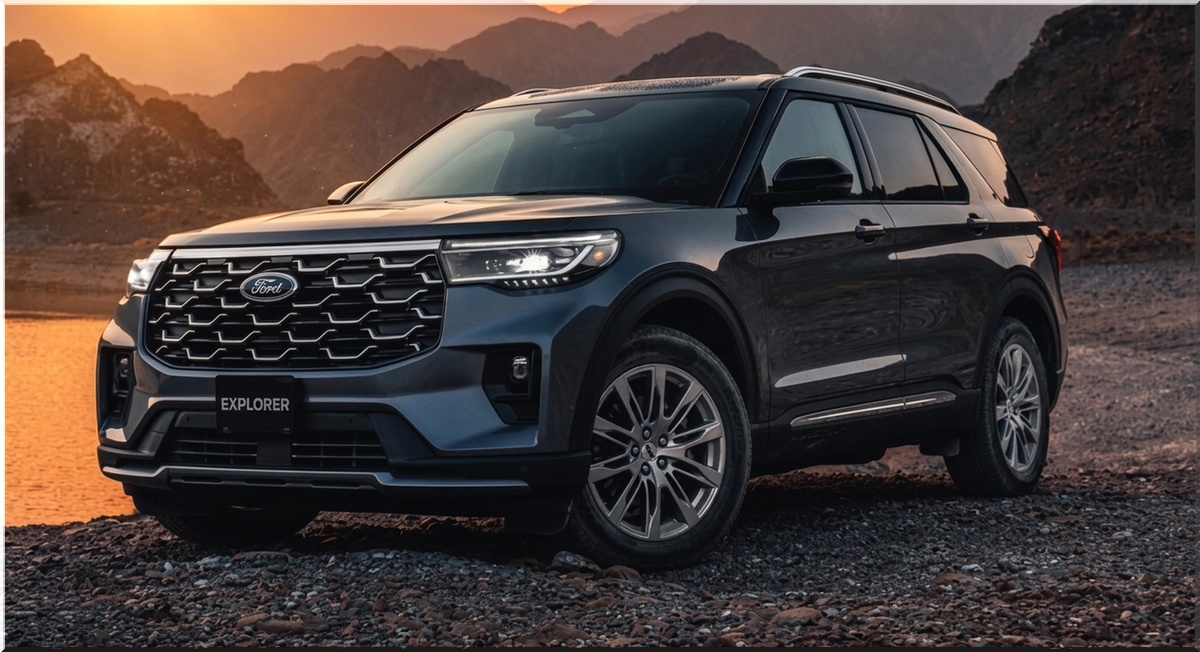
Ford Explorer Specifications
Wheelbase: 119.1 inches
Length: 198.8 inches
Width without mirrors: 78.9 inches
Height: 69.6 inches
Ground clearance: 8.2 inches
Cargo capacity: 87.8 cu ft
Turning diameter: 38.7 ft
Max towing: 5,000 lbs
Max horsepower: 300 hp from the 2.3L EcoBoost I-4
Max torque: 310 lb-ft at 3,500 rpm
Base MSRP: $40,160
The Ford Explorer debuted in 1991 as one of the first road-focused SUVs. It helped create the three-row crossover segment that now dominates American driveways. Over 30 years of production, the Explorer has accumulated millions of units on the road.
The Escape tells a different story. Production ended on December 17, 2025, when the final unit rolled off the line at Louisville Assembly Plant in Kentucky. The nameplate spanned four generations and 25 years. Ford built a substantial stockpile before the shutdown, so dealers continue selling new examples well into 2026. The Escape holds a 1.2% share of vehicles on the road despite no longer being in production.
Ford Escape Specifications
Wheelbase: 106.7 inches
Length: 180.5 inches
Width without mirrors: 74.1 inches
Height: 66.1 inches
Ground clearance: 7.5 inches
Cargo capacity: 37.5 cu ft
Turning diameter: 38.4 ft
Base engine: 1.5L EcoBoost I-3, 180 hp, 199 lb-ft
Available engine: 2.0L EcoBoost I-4, 250 hp, 280 lb-ft
Hybrid option: 2.5L Atkinson Cycle I-4
Base MSRP: $30,350
The Escape's discontinuation represents a strategic pivot. Ford retooled the Louisville plant to manufacture a $30,000 electric truck. That decision reflects CEO Jim Farley's stated focus on affordable electrified models rather than high-end EVs. The hybrid Escape variant, which paired a 2.5-liter Atkinson-cycle engine with an electric motor, will continue to influence Ford's hybrid strategy through the Maverick and F-150 PowerBoost.
Super Duty F-250: The Workhorse That Never Quits
The Ford F-250 Super Duty claims 1.1% of all vehicles on American roads, tying with the Jeep Grand Cherokee, Nissan Rogue, and Nissan Altima for the fifteenth spot. That share has not changed over the past several quarters.
Ford F-250 Super Duty Specifications
GVWR for Lariat: 10,600 lbs
GCWR: 23,500 lbs
Max payload: 2,955 lbs
Max conventional towing: 22,000 lbs
Max gooseneck towing: 23,000 lbs
Diesel torque: 1,050 lb-ft from the 6.7L Power Stroke V8
Base MSRP for Lariat: $64,034
The Super Duty appeals to commercial fleets, construction operators, and heavy-towing consumers who need capability that exceeds what a half-ton truck can deliver. Ford's decision to ramp up production in recent months underscores the model's sustained demand. The 6.7-liter Power Stroke diesel V8 produces 475 hp and 1,050 lb-ft of torque in standard output form, while the high-output variant pushes torque to 1,200 lb-ft.
From an expert perspective, the Super Duty's presence on this list reflects the commercial backbone of the American economy. These trucks accumulate high mileage quickly, but their diesel powertrains routinely exceed 300,000 miles before major service. That durability keeps them registered and on the road far longer than the average passenger car.
The Broader Fleet Context: Why Ford's Lead Holds
Three structural factors explain Ford's consistent position atop the most-common-brand list.
First, cumulative volume. Ford has produced tens of millions of F-Series trucks, Explorers, and Escapes over the past four decades. Each model year adds to the total, and vehicles remain registered for an average of 12.8 years. The average light truck on U.S. roads is 11.9 years old.
Second, model longevity. The Explorer has been in continuous production since 1991. The F-Series has existed since 1948. These nameplates have built recognition and loyalty across generations of buyers.
Third, registration dynamics. There are 295.3 million vehicles on U.S. roads, with 15.9 million newly registered in the past year. Full-size pickup trucks represent 16.6% of that total fleet. Ford's share of this massive pool is difficult to displace because the replacement cycle is measured in decades, not quarters.
Experian reports minimal change in vehicle order or percentages between Q1 and Q2 2026. That stability has persisted across multiple quarters. The F-150 will not lose its crown soon, particularly as it continues to top nearly every new-vehicle sales chart each year.
Should I buy an F-150 or a Silverado for long-term ownership? The F-150's higher registration volume means more parts availability, stronger dealer service networks, and better aftermarket support. The Silverado's 2.8% share is substantial, but Ford's 3.7% translates to roughly 10.9 million F-150s on the road versus 8.3 million Silverados. That volume advantage lowers repair costs and shortens wait times for components.
Electrification's Role in Ford's Road Presence
Ford's electrified vehicle sales declined in Q2 2026, with EV volume down 40.7% to 9,746 units and hybrids down 20% to 53,163 units. The Mustang Mach-E posted 7,032 units, a 30.9% year-over-year decline. The F-150 Lightning, now discontinued, moved 2,421 units.
Yet these figures have not yet registered in the cumulative on-road data. Electrified vehicles represent a small fraction of Ford's total fleet, and the registration data reflects all model years. The Maverick Hybrid set a Q2 record at 29,457 units, up 19.3%, while the F-150 PowerBoost retained its title as the best-selling full-size hybrid pickup.
Ford's long-term strategy focuses on hybrids, extended-range electric vehicles, and smaller affordable EVs. The company plans to introduce an EREV version of the F-150 Lightning and has committed to offering electrified powertrains on 90% of its global nameplates by the end of the decade. Those vehicles will eventually appear in the registration data, but their impact will take years to materialize given the 12.8-year average vehicle lifespan.
The Bottom Line
Ford's 14.4% brand share and the F-150's 3.7% model share reflect decades of production volume, model longevity, and fleet durability. The Explorer and Escape add another 2.4% combined, while the Super Duty contributes 1.1%. Together, these nameplates form the backbone of American roadways.
The data shows no sign of a shift. Experian's Q2 2026 report reveals the same rankings and percentages that have held steady for multiple quarters. Ford's lead over Toyota and Chevrolet remains narrow in absolute terms, but the cumulative nature of registration data makes large swings unlikely in the near term.